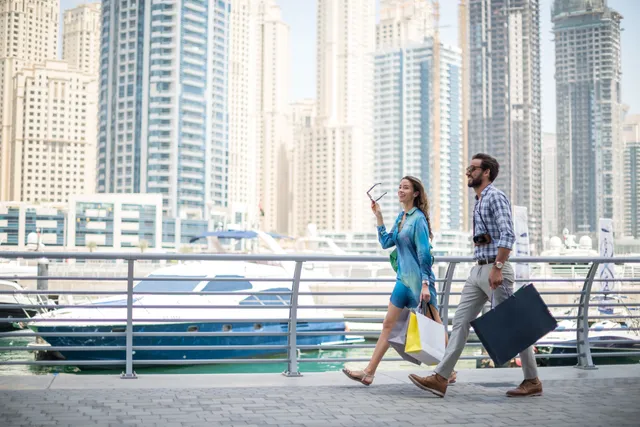
Dubai's resident population passed 4.5 million at the end of 2025 and reached 4.74 million by the second quarter of 2026, a gain of over 160,000 people in six months, according to Digital Dubai's population figures.
Dubai's population has crossed 4.74 million after the emirate added more than 161,000 residents since the beginning of 2026, according to the Dubai Population Clock. That is well ahead of where most forecasts placed the city for this point in the decade and it matters well beyond the headline number. Every one of those residents shops, works, eats and does business somewhere and that "somewhere" is what underwrites occupancy, rental growth and going-concern valuations across Dubai's commercial property market.
Population Growth as a Commercial Demand Engine
Commercial Segment | Population Growth Impact in 2026 |
Business formation drives 94% occupancy; AED 238/sq ft average (Q2 2026 market data) | |
Community retail in new developments: occupancy above 85% | |
E-commerce + supply chain: 12.3M sq ft H1 2026 demand (H1 2026 market data) | |
Going Concerns | 4M consumers underpin restaurant, retail and wellness business valuations |
Offices: Occupancy Holding Near Capacity
Office occupancy at 94% is not a market with meaningful slack. A growing resident population feeds a growing base of company registrations and expanding headcounts, and Dubai's office stock has been absorbing that demand without significant erosion in rents, the AED 238/sq ft average for Q2 2026 reflects sustained, rather than softening, occupier demand. For corporates weighing expansion or relocation, this is a market where availability, not price negotiation, is increasingly the constraint.
Retail: Community Assets Benefiting Most Directly
Retail demand tracks population growth more immediately than most other segments, because retail catchments are local. Community retail in newer residential developments running above 85% occupancy reflects a straightforward pattern: as new communities fill with residents, ground-floor retail and neighbourhood F&B units are the first assets to be absorbed. This is a segment where population growth and property performance move almost in lockstep.
Industrial and Warehouse: Structural, Not Seasonal, Demand
The 12.3 million sq ft of industrial and warehouse demand recorded in H1 2026 reflects two overlapping drivers, e-commerce growth and broader supply-chain expansion, both of which scale with population and consumer spending. This is demand with structural rather than cyclical underpinnings: as Dubai's resident and daytime populations grow, so does the logistics infrastructure required to serve them.
The Trajectory to 2040: What the Master Plan Implies for Commercial Demand
Dubai's 2040 Urban Master Plan set a target of 5.8 million residents by 2040, up from a 2020 baseline of 3.3 million. With the population already at 4.74 million in mid-2026, Dubai is tracking meaningfully ahead of a straight-line path to that target, which is a relevant signal for anyone underwriting a long-hold commercial property investment.
For commercial property investors, a city moving from roughly 3.3 million to 5.8 million residents over two decades represents one of the clearer, better-documented demand theses available in global real estate: the growth driver isn't speculative, it's a published government planning target and the market is currently running ahead of schedule rather than behind it. CRC Property tracks population growth at the community level and connects investors to the commercial assets best positioned for this trajectory — secondary-market pricing and pre-let activity in the fastest-growing micro-markets will be worth monitoring closely over the coming quarters.
Contact CRC Property to identify the right investment for your long-term strategy.
What This Means for Investors and Occupiers
- Investors evaluating retail and F&B assets should prioritise micro-markets where resident population has outpaced retail supply — Dubai South and the emerging master communities stand out.
- Corporate occupiers planning office expansion should treat 94% occupancy as a signal to move early; availability, not pricing pressure, is the binding constraint in the current market.
- Landlords in established community retail nodes are operating from a position of strength, with occupancy above 85% giving room to be selective on tenant mix.
- Developers assessing new schemes should weight population growth trajectories by micro-market rather than relying on citywide averages, given how unevenly demand is currently distributed.
Frequently Asked Questions
What is Dubai's population in 2026?
Dubai's population is approaching 4 million in 2026, continuing a sustained growth trajectory that is directly shaping demand across the commercial property market.
How does population growth affect commercial property prices in Dubai?
Population growth drives business formation, consumer demand and workforce expansion — all of which feed directly into commercial property performance. In 2026, this is reflected in 94% office occupancy, community retail occupancy above 85% and 12.3 million sq ft of new industrial and warehouse demand recorded in H1 2026.
Which Dubai areas are growing fastest for commercial property in 2026?
Dubai Hills and MBR City are leading demand for premium retail and F&B space. JVC and Al Furjan are driving strong community retail demand from their large residential populations. Dubai South is seeing rising demand for F&B and services property from its growing workforce, while Palm Jebel Ali and Tilal Al Ghaf are emerging as new master communities with accelerating ground-floor retail demand.
What is Dubai's population target for 2040?
Under Dubai's 2040 Urban Master Plan, the city is targeting a population of 5.8 million, up from approximately 4 million today. For commercial property investors, this growth path represents one of the clearest long-term demand theses in the global real estate market.
Table of Contents
Recent Posts
- The Complete Guide to Dubai Visa Types: Which One Is Right for You?
- Best Schools in Dubai for 2026–2027: The Complete Guide for Families
- Best Summer Activities for Kids in Dubai: The 2026 Ultimate Guide for Parents
- The Best Brunch in Dubai 2026: Your Ultimate Weekend Guide
- Best Hotel Deals in UAE: April 2026